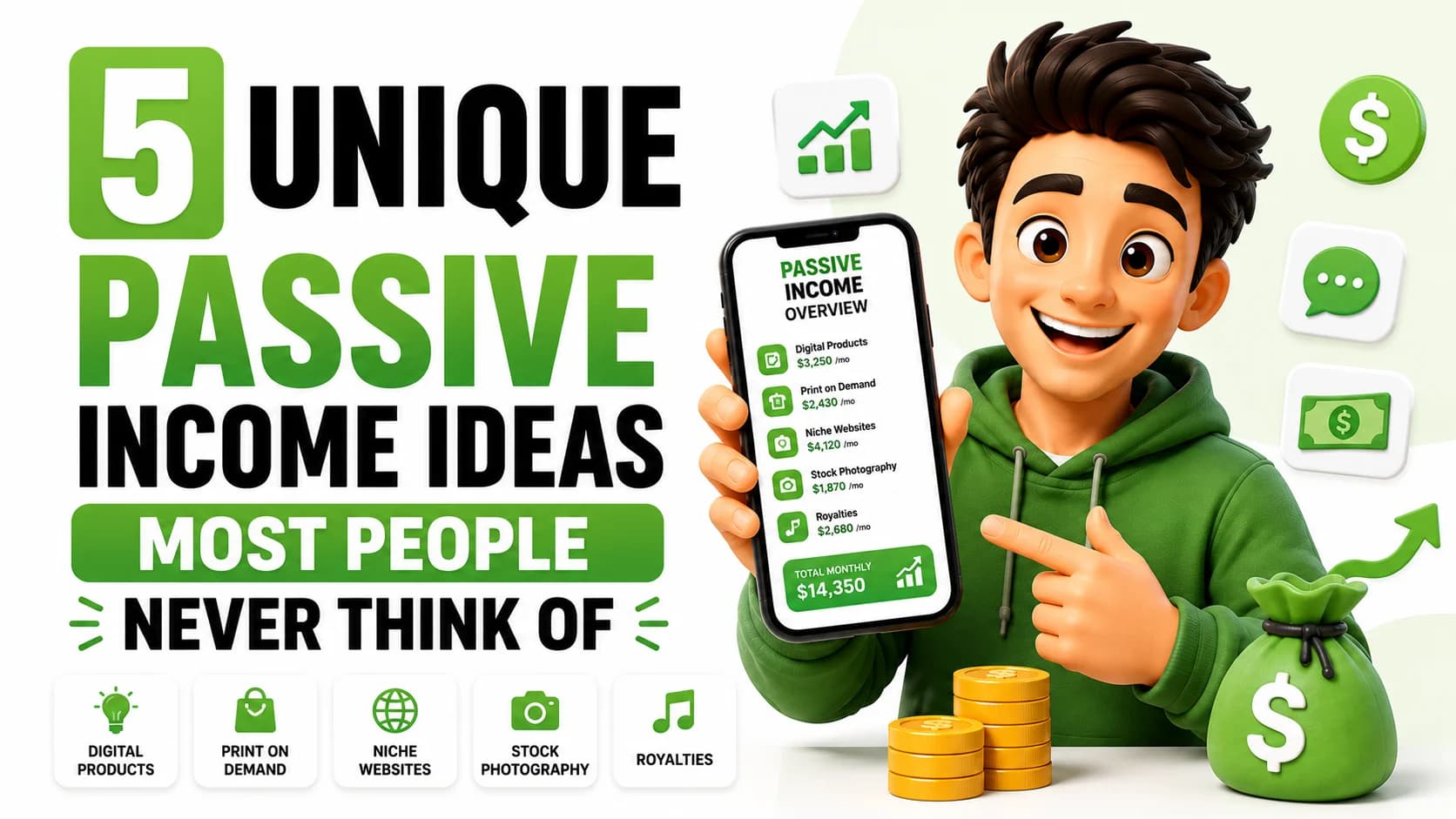
5 Unique Passive Income Ideas Most People Never Think Of
Five leveraged income ideas that actually go beyond the usual blogging and dropshipping advice. Plus, what to watch out for with each one and the investment.
Picture this. You're on a beach, drink in hand, and money's just... showing up in your account. Nice idea, right? Here's the thing, though. Passive income like that doesn't really exist. What does exist is leveraged income, and it's not the same thing at all.
Leveraged income means you put in real work upfront, sometimes real money too, and in exchange you build something that keeps paying you long after the initial effort. It's not passive. It's just front-loaded. And most people chasing "passive income" give up because they expected the beach-and-cocktail version and got the actual version instead: risk, time, and a fair bit of trial and error.
The best leveraged income ideas solve a problem that isn't already flooded with competition. People call this finding a "blue ocean" instead of a red one, red being where everyone's fighting over the same customers. So here are five ideas that don't show up in every other "passive income" list you've read.
Idea 1: Spotify Playlists
Low risk here, moderate effort. This one's actually kind of a hidden gem because barely anyone talks about it.
Here's how people stumble into this. You click on a playlist ad on Instagram, maybe because the music sounded good for working. Download it. Forget about it. Then suddenly you're getting bombarded with more playlist ads. It turns out a lot of these aren't run by Spotify; they're run by regular people who built a playlist and grew a following, and now they're monetizing it.
There are two main ways to make money off a playlist like this. One, charging up-and-coming artists to get featured, since new artists want streams more than almost anything. You could even charge different rates depending on how high up the playlist their song lands. Sounds good on paper, but it's actually against Spotify's terms of service, and it's not very passive either since you're constantly negotiating with individual artists.
The better route is a Patreon-style setup. Artists pay a small monthly fee, say $5, for the chance to submit music for consideration. You review it, add what you actually like, and the money comes in automatically every month. Get a thousand artists paying $5, and that's $5,000 a month. It also just feels more honest, because you're choosing songs you actually want on the playlist instead of taking money for anything and everything. And once you've built one playlist like this, nothing's stopping you from doing it again in a different genre.
Idea 2: Merch by Amazon
Low risk, higher effort. This one solves a real problem: the stock problem.
Imagine spending your savings printing a few thousand shirts of a design you love, only for them to barely sell. Then, out of nowhere, one specific design takes off somewhere you didn't expect, and you've got no stock left to meet the demand. That's the trap of traditional print-and-hold merch. You're guessing what'll sell before you know anything.
Merch by Amazon skips that entirely. You upload a design, pick your colors, set your price, and Amazon handles printing and shipping only when someone actually buys. No upfront cost, no guessing how many of each size to print. If a design does nothing, you've lost basically nothing. If it takes off, Amazon just keeps printing more.
One real thing to watch out for: don't touch copyrighted material. You can't just slap a design that rips off Disney or any other IP onto a shirt and expect that to go anywhere but a takedown notice.
Idea 3: Vending Machines
Higher risk, higher effort, but the market's genuinely bigger than people assume. Selecta, one of the largest vending operators in Europe, pulled in over €1 billion in revenue in 2021, up a few percent from the year before. That's not a shrinking market.
Here's the thing about vending machines, though: an old, underpriced machine can actually lose money. Maintenance costs, restocking time, and prices too low to raise without upsetting people who got used to the old price, all of that adds up against you. What tends to work is someone coming in, installing better machines, handling all the maintenance and restocking themselves, and taking a cut, something like 15% of revenue, while the location owner gets happier staff and zero hassle.
The real key is location. Find a spot with genuine foot traffic and unmet demand, work out a deal with whoever runs that space, and start with a used machine if you're low on capital; they go for cheap online. Match what you stock to what people at that specific location actually want, and once a few machines are running well, you can expand and eventually hire people to manage it so you're not the one refilling snack machines forever.
Idea 4: SaaS (Software as a Service)
High risk, high effort, but the ceiling is enormous if it works. SaaS means building software people pay to use, usually monthly.
A common mistake early on is selling software as a one-time purchase. It works, technically, but you're constantly chasing new customers to replace the ones who already bought. Switch to a subscription model instead, and suddenly you're building real, compounding value; customer lifetime value goes up, revenue gets predictable, and the whole business becomes something you could eventually sell for a real multiple of its earnings.
To get here, you need to pick who you're serving first: businesses or everyday consumers. Selling to businesses tends to be the less risky route since you can charge more per customer. Then you build something that actually solves a specific, painful problem for that audience. Funding-wise, if what you've built is genuinely good, you often don't need outside investment at all. Bootstrapping, funding it with your own revenue as you grow, is entirely possible if the product earns its keep early.
Idea 5: Digital Downloads
Low risk, moderate-to-high effort depending on what you make. Everyone's talking about e-commerce and dropshipping. Fewer people are talking about digital products, and that's exactly why there's room here.
The appeal is obvious once you think about it: no stock to run out of, no shipping costs, nothing physical to manage at all. Templates, printables, stock footage, eBooks, email templates, online courses, and YouTube banners—the format barely matters as long as it solves a real problem for a specific group of people.
The formula that tends to work: notice a specific problem someone actually has, build something that solves it cheaply and quickly, then realize that if one person needed it, plenty of others probably do too. Digital products built this way, out of solving a real, narrow problem rather than guessing at a broad market, tend to outperform generic "just make a course" advice.
Idea 5.5: Investments
Variable risk depending on what you pick, low effort once it's set up. Yeah, investing isn't exactly a hidden gem. But leaving it off this list would've felt wrong, because it's genuinely the closest thing to real passive income you'll find.
Stocks, real estate, and yes, crypto, if you're comfortable with the volatility, are all reasonable long-term plays. The keyword there is long-term. Chasing huge, fast gains is how people lose everything, and there are plenty of examples of coins and assets that collapsed hard and fast for people who got greedy at the wrong moment.
Two practical things worth doing early. First, open a tax-advantaged account if your country offers one—an ISA in the UK or a Roth IRA in the US—and max out your contributions where you can, since the gains inside those accounts are tax-free. Second, keep the old Buffett line in mind: be fearful when others are greedy, and greedy when others are fearful. Cliché, sure, but it holds up.
The Part That Actually Matters
People love saying you need multiple income streams, and there's truth in that. But most people misread what it actually means. It doesn't mean dabbling in five things at once with no real commitment to any of them. One foot in and one foot out gets you nowhere. Pick something, actually build it properly, and add a second stream once the first one has real traction, not before.
Passive Income · October 24, 2026
Back to the front page