How Small YouTube Channels Out-Earn Channels With Millions of Views
Learn how subscriber count and AdSense revenue don't predict YouTube income and how a small, focused channel can out-earn a much larger one.
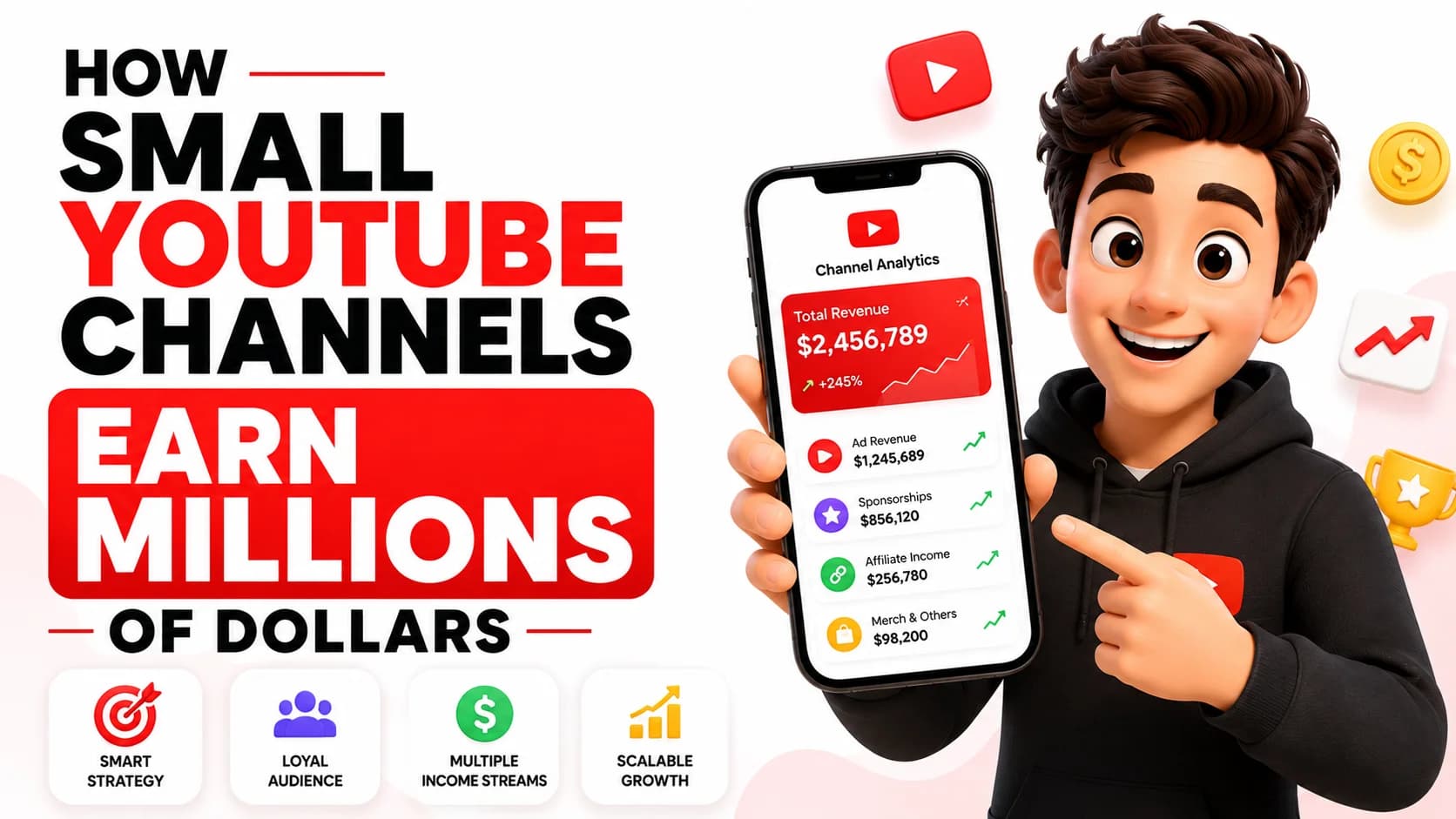
A channel with a few thousand subscribers can out-earn one with hundreds of thousands, and the reason isn't luck. It comes down to what's actually being optimized for. Chasing views and subscriber count is a fundamentally different game than building a channel around a specific transformation people are willing to pay for. In this blog, we will break down why AdSense alone rarely builds a real business, why audience size is a weaker signal than it looks, and how a small, focused channel can consistently outperform a much larger one.
How AdSense Alone Rarely Builds a Real Business
AdSense pays roughly 1 to 3 cents per view depending on niche and audience location. To reach $100,000 a year from ad revenue alone, a channel typically needs somewhere between 3 and 10 million views annually, consistently, year after year. That's an achievable number for a small fraction of creators and an unrealistic target for almost everyone else, since YouTube's ad economy is fundamentally an attention-based system where the largest rewards concentrate around the channels with the greatest reach.
For most creators building a business around their expertise, this makes AdSense a weak foundation to plan around, not because the platform doesn't pay, but because the math only works at a scale most channels will never reach.
The Dollar-Per-View Reframe
There's a different way to measure a channel's value entirely: dollar per view, rather than raw view count. Instead of asking how many people watched a video, the more useful question is how much value each view actually generated for the underlying business.
Consider a channel producing a video that gets a modest 7,000 views but is tightly aligned with a specific paid offer. If that single video generates even a handful of clients over several months at a meaningful price point, the effective value per view can run into dollars, not fractions of a cent, dramatically outperforming what the same view count would earn through ad revenue alone. The view count doesn't change; what changes is whether the content is built to convert a specific audience into paying clients, rather than simply accumulate watch time.
Why Audience Size Is a Deceptive Metric
Large audiences don't automatically translate into revenue, and the gap between the two is often stark. A channel with a small, highly targeted following of people who have real intent to solve a specific problem can meaningfully outperform a channel with an audience many times larger built around broad entertainment or relatability content.
This happens because platforms are structurally designed to reward engagement and watch time, which serves the platform's own goals, not necessarily a creator's underlying business. An audience built purely on entertainment value, with no consistent tie to a specific transformation or outcome, often has no built-in reason to buy anything when a product or offer eventually gets introduced. Attention and purchase intent are not the same thing, and conflating them is one of the most common reasons large audiences fail to convert into meaningful revenue.
From Information to Transformation
YouTube functions primarily as an information source. What actually gets purchased is transformation, a specific, tangible change in someone's situation. A creator doesn't need to be the most credentialed expert in a field to build real value here; they simply need to be genuinely ahead of the people they're teaching, with real, hands-on experience to draw from.
This distinction shapes how a channel should be built from the outset. Rather than building an audience first and figuring out monetization later, the more effective sequence is identifying the specific transformation being offered first, then building content that attracts exactly the people who need that transformation.
Mastery, Method, Mentorship
A useful framework for turning expertise into a scalable business follows three stages. Mastery is the hands-on experience and real-world results a person has already built through direct practice. The method is organizing that experience into a clear, repeatable process someone else could follow. Mentorship is delivering that method at scale, through a course, program, or coaching structure, rather than one-on-one time indefinitely.
YouTube's role in this framework is specific: it demonstrates mastery and builds trust in the method, functioning as proof rather than as the business itself. The actual business is the packaged method and its delivery system; YouTube is simply how the right people discover it.
YouTube as a Search Engine, Not a Social Platform
Unlike platforms built around social feeds and short-lived content, YouTube functions much closer to a search engine. People arrive with active intent, looking to solve a specific problem or learn something concrete, not primarily to be entertained. That intent-driven behavior is exactly what makes a well-targeted channel valuable even at a small scale; the viewers arriving are self-selecting for relevance in a way that broader social platforms don't naturally filter for.
Videos also behave differently here than on platforms with a short content lifespan. A video published years ago can continue generating qualified leads indefinitely, functioning as a compounding, evergreen asset rather than content with a 24-to-48-hour shelf life.
Building a Funnel Around Viewer Awareness
Not every viewer is ready to become a client immediately, which is why structuring content around three levels of awareness matters.
1. Top-of-funnel viewers aren't fully aware they have a specific problem yet; they're just beginning to explore what's possible. Content here should build trust and authority, typically pointing toward a low-barrier entry point like a free guide or lead magnet that moves the viewer onto an owned email list rather than leaving them dependent on the algorithm to resurface future content. 2. Middle-of-funnel viewers already recognize their problem and are actively comparing solutions. Deeper content, a webinar, a detailed training, or a walkthrough of a specific methodology fits well here, again funneling toward an email list rather than keeping the relationship confined to the platform itself. 3. Bottom-of-funnel viewers are ready to invest and want the full transformation, not just more information. For this group, a direct path to purchase, booking a call, or enrolling in a program is the appropriate next step, since further education at this stage often just delays a decision that's already been made.
Why This Compounds Over Time
Once this structure is in place, the mechanism repeats on its own: a viewer discovers a video aligned with a real problem, watches it, joins an email list, receives further trust-building content, and eventually converts into a client. Because YouTube content persists rather than expiring within a day, this cycle keeps running indefinitely on existing content, building what functions as an evergreen client pipeline rather than a one-time content push.
Four Steps to Building an Expertise-Based Business
1. Identify the transformation, not just the information, that your specific experience allows you to deliver 2. Organize that experience into a clear, repeatable method others can follow 3. Package that method into a structured offer that doesn't require unlimited one-on-one time to deliver 4. Use YouTube to demonstrate the method and build trust, functioning as the discovery vehicle rather than the business itself
Creator Economy · October 24, 2026
Back to the front page