
12 Ways to Make Money With SEO, Ranked From Worst to Best
A tier-ranked breakdown of 12 ways to actually make money with SEO skills, from in-house jobs to niche agencies, with the real pros and cons of each.
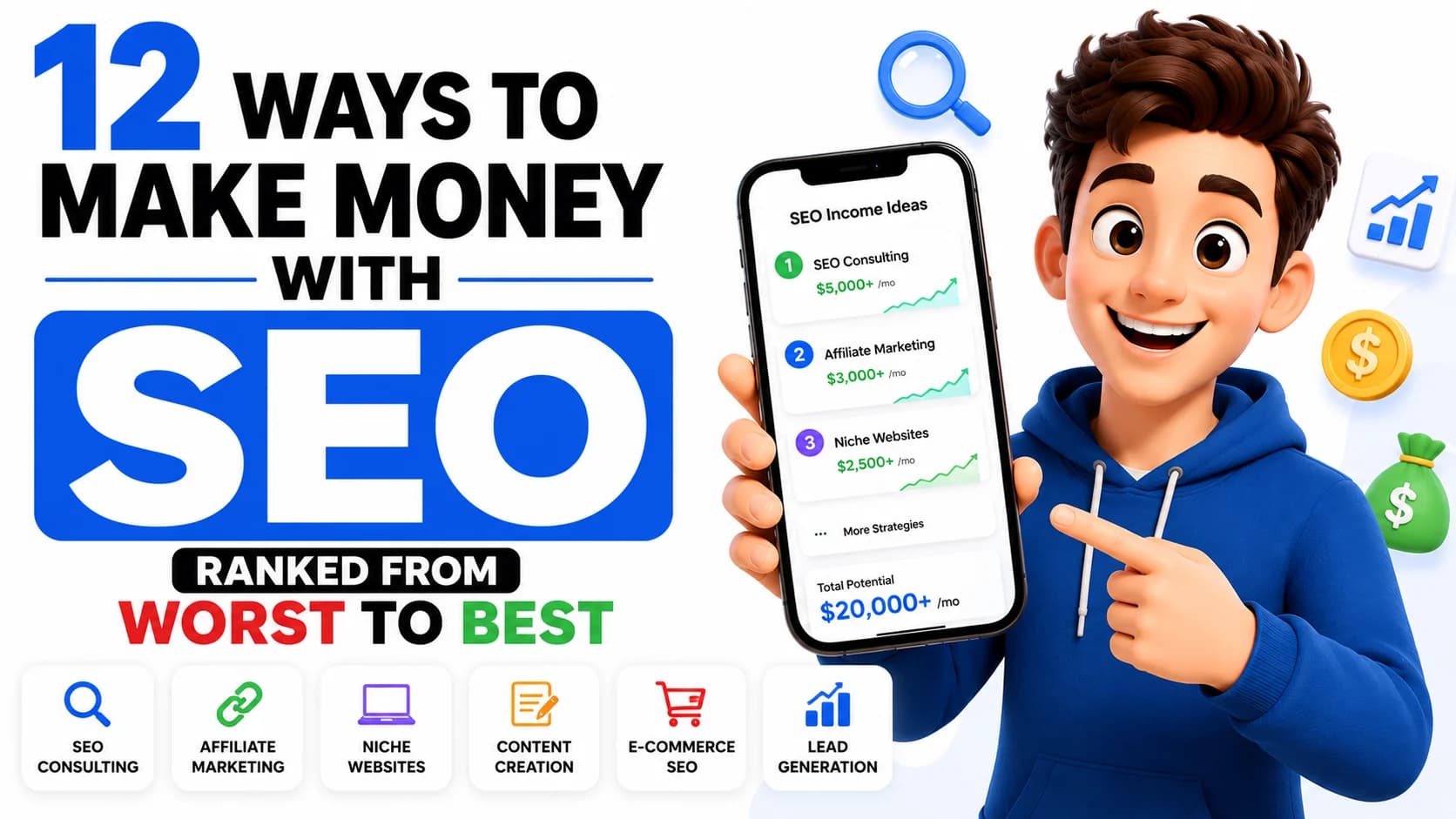
SEO is a genuinely valuable skill, but not every way of monetizing it is worth your time equally. Some options look great on paper and fall apart once you actually try them. Others barely get talked about and end up being some of the best ways to build real income. So here are all twelve, ranked from the ones I'd avoid to the ones actually worth chasing.
F Tier: SEO Software (SaaS)
High income potential, sure, but also brutal to break into. Building SEO software typically needs anywhere from $10,000 to $30,000 just to get an MVP off the ground, and that number climbs fast into six figures once you need to hire developers. On top of that, you're stepping into a market with hundreds of competing tools already out there, some backed by serious venture money. Semrush, for example, raised $40 million in VC funding back in 2018 before going public in 2021 and eventually being acquired by Adobe in late 2025. That's the kind of competitor you'd be up against. Not impossible to break in, but a rough starting point if you're new to SEO.
F Tier: Link Building Agency
Selling backlinks can genuinely make money; people have made real income doing exactly this. But the margins are thin now, since quality placements cost more than they used to, and eating into an already-small margin makes the whole model tighter than it looks from outside. The bigger issue is saturation. Everyone's running a link-building service these days, which means standing out generically just doesn't work anymore. If you're going to try it, the smarter move is picking a specific angle, focusing purely on B2B SaaS clients, for instance, rather than trying to be a generalist link builder in an already crowded space. Reselling an established, higher-quality white-label link-building service under your own brand is another workaround worth considering instead of building the whole operation from scratch.
D Tier: In-House SEO Professional
Steady, sure, but capped hard. The average US SEO professional salary sits around $62,000, and even climbing to an SEO director role tops out somewhere near $142,000 before taxes, roughly $96,000 take-home. That's genuinely solid pay, top 1% globally even, but here's the catch: it's still a ceiling. Most people never reach director level, and even the ones who do eventually hit the top of what the role pays. And job security is mostly an illusion; a layoff can wipe out that income overnight regardless of how skilled you are. The real lesson here: the only actual security is in how valuable your skills are, not the job title attached to them.
D Tier: Authority Websites
Unlimited income potential, genuinely. Once a site has real authority and consistent traffic, you can monetize however you want: ads, affiliate offers, consulting, whatever fits. Authority sites also tend to survive Google's algorithm updates better than most other SEO plays, since a strong backlink profile and years of content history buffer against the worst of the volatility. The catch is the investment required to get there: years of consistent content work and a serious time commitment before it actually pays off. Not a fast path, and not a beginner-friendly one either.
C Tier: Micro Niche Websites
This one's underrated. Barely any capital needed, just a domain and hosting, and it's low risk enough that you don't need a decade of SEO experience to see real results. The real value here isn't necessarily the site itself; it's what it leads to. A microsite that ranks well becomes proof of skill you can use to land actual SEO clients, and the revenue from those clients can then get reinvested into something bigger, like an authority site down the line. Think of it as a stepping stone rather than the end goal, which makes it a genuinely solid starting point for beginners.
B Tier: One-on-One SEO Consulting
Zero upfront capital, low risk, and you can start literally today if you already know your stuff. The tradeoff is obvious, though: your income is capped by your own hours. There's only one of you, and consulting doesn't scale the way a product or service business can. Solid income, real flexibility, but a ceiling that's hard to get past without eventually building a team or productizing your offering.
A Tier: Productized SEO Services
This is genuinely underused. Instead of trying to be "the SEO guy" for everyone, positioning yourself as the specific expert in something narrow, on-page optimization, content optimization, or whatever your specialty is, cuts competition dramatically and makes building a recognizable brand around that one thing much easier. The tradeoff is that a narrow, productized service generally isn't as high-ticket as full-service SEO work, so front-end income is somewhat capped. But volume and repeat business on the back end can make up for that fast.
A Tier: White Label SEO Services
Barely any upfront capital, low competition compared to running your own agency-facing brand, and you only need a handful of agency clients to make this genuinely lucrative. Here's the math that makes it work: one agency client alone might hand you ten campaigns to fulfill, which can realistically put you over $1,000 a month from that single relationship. The agency handles all the marketing, sales, and client-facing work; you just execute.
S Tier: City-Focused SEO Agency
Instead of trying to compete nationally, picking one city and becoming the go-to SEO provider there is a genuinely underrated move. Local competition is almost always lower than people assume, and ranking for a specific city-plus-service keyword can become a durable, long-term lead source that keeps producing long after the initial ranking effort. People consistently underestimate how much opportunity sits in hyper-local SEO compared to trying to compete broadly from day one.
S Tier: Niche SEO Agency
This one combines the best of a few worlds: the scalability of client services, but with lower competition and easier marketing and sales because you're speaking directly to one specific industry's exact language and pain points. A general SEO agency competes against everyone. An agency that exclusively serves, say, law firms or dental practices only competes against the small number of other agencies doing the same thing and can command higher rates because of that specialization. This is consistently one of the strongest models on this entire list once it's dialed in.
The Common Thread
Look at the tiers that actually work well: productized services, white label, city-focused, niche agencies, and the pattern is obvious: narrow focus beats broad competition every time. The worst-performing options on this list, SaaS and generic link building, both suffer from the same problem: too much competition, too much capital required, or both. Picking a specific, defensible angle instead of trying to serve everyone is really the throughline across every good option here.
The website, if it doesn't make much money directly? It works as a low-risk proof of skill that can help land actual paying clients, with that client revenue eventually reinvested into a bigger, more lucrative project.
Digital Marketing · October 24, 2026
Back to the front page