Selling Products vs. Selling Services: What Actually Determines Success
Compare selling physical products versus services as a business model. Understand margins, control, scalability, and which path actually fits your situation.
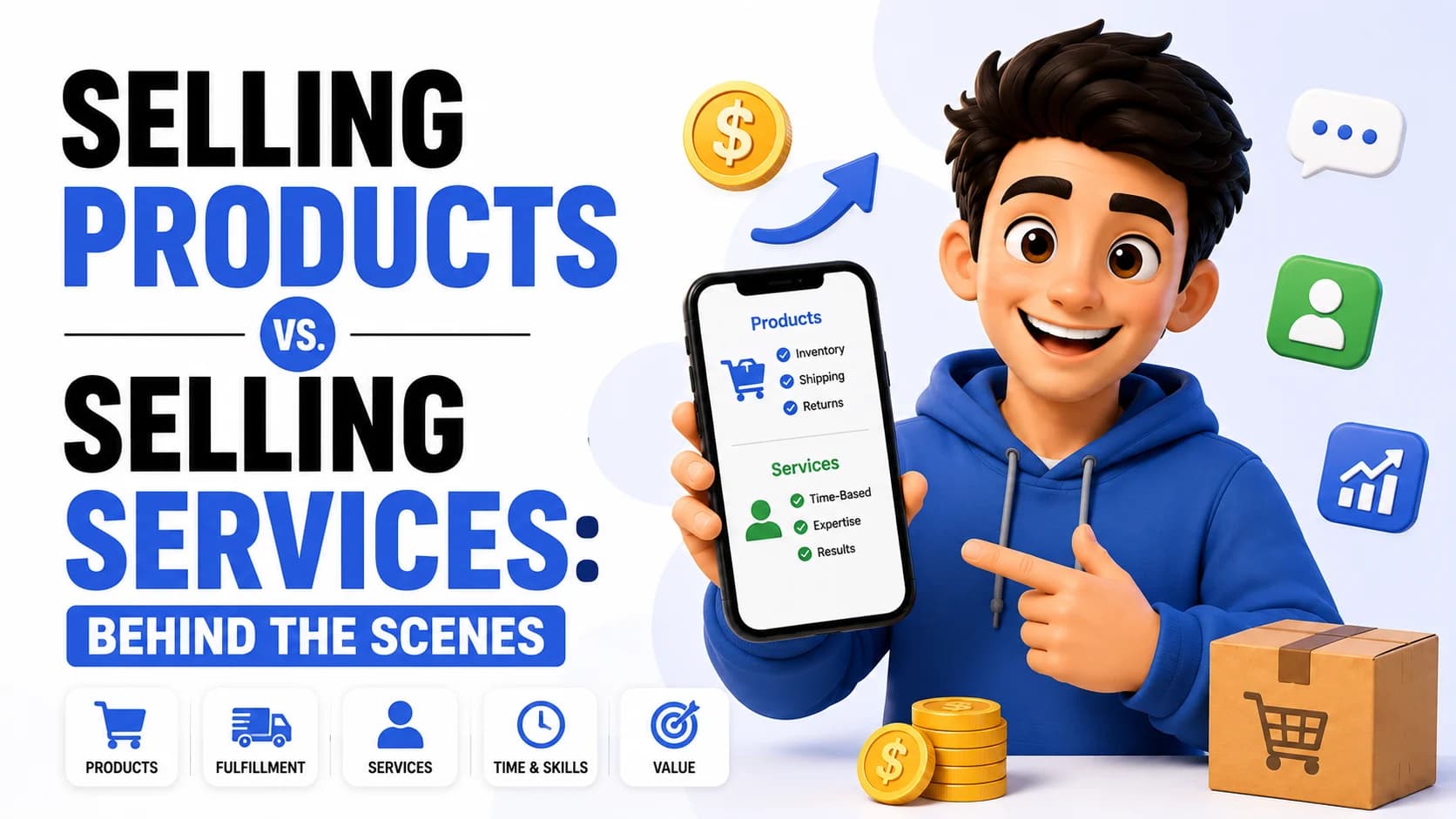
Every new business idea eventually gets sorted into one of two buckets: something tangible you can hand a customer, or something intangible built entirely on skill and time. Both can genuinely work, and both fail for very different reasons. In this blog, we will break down what actually goes wrong with product businesses that looked promising at first, why service businesses often outperform expectations once trust is established, and how to think about which one actually fits your situation.
Why Physical Products Are Easy to Market But Hard to Sustain
A physical product has an obvious marketing advantage: it can be seen, described, and demonstrated. Color, material, dimensions, functionality—all of it is concrete and easy to put in front of a buyer. That's exactly why physical products often generate quick early traction and exactly why so many first-time entrepreneurs start there.
The problem shows up later, once the initial excitement fades and the underlying economics start to matter more than the product photos.
The White-Label Trap
Most people entering product sales today aren't developing anything original; they're sourcing white-label goods, generic products a supplier will brand under any name, and reselling them at a markup. That's not inherently a bad strategy, but it comes with a structural weakness: if a product is easy for one person to source and brand, it's equally easy for dozens of others to do the same thing with the identical item.
Once a product has no real differentiation, competition shifts entirely to price and ad spend. That dynamic tends to compress toward a race to the bottom, where margins shrink from constant undercutting, and marketing budgets climb just to maintain the same sales volume as before, eating into whatever profit was left.
Quality Control You Don't Actually Control
Selling a physical product means carrying risk for something largely outside direct control: manufacturing consistency. A tested sample doesn't guarantee the next production batch matches it, and this risk compounds significantly under a dropshipping model, where the seller never physically handles the product at all, relying entirely on a supplier's fulfillment and quality standards.
The Chargeback Problem Nobody Warns You About
Shipping delays are common and largely outside a seller's control once an order leaves the warehouse. When a product arrives late, a meaningful portion of customers contact their bank directly rather than the seller, filing a chargeback claiming non-delivery. Occasionally the product then arrives shortly after the dispute is filed, but the chargeback has often already gone through, and there's frequently little recourse to recover that revenue even once the product is confirmed delivered.
This isn't a rare edge case; it's a structural cost of selling physical goods through modern logistics networks, and it needs to be priced into the business model rather than treated as an occasional surprise.
Rising Costs on Both Sides of the Equation
Product costs and shipping costs both trend upward over time, and the same is true of paid advertising. Platforms like Facebook, Instagram, TikTok, and Google run on an auction-based bidding system; anyone selling a similar product is directly bidding against every other seller targeting that same audience. As competition in a category increases, so does the cost to reach the same customer, which is exactly the mechanism behind the margin compression white-label sellers often run into.
At a certain point, a seller earning just a few dollars of margin per unit, while spending significant time resolving customer issues, delivery disputes, and refund requests, is running a business that consumes far more effort than the numbers justify.
Why Services Flip the Economics
Services operate on a fundamentally different structure. There's no manufacturing risk, no shipping dependency, and no chargeback exposure tied to a physical product failing to arrive. What's being sold is knowledge, skill, or time, which means the barrier to entry is passion and expertise rather than capital or supply chain access.
Genuine interest in a subject, whether that's fitness coaching, video editing, writing, or consulting, tends to produce continually improving expertise simply because the work itself stays engaging. That combination of real knowledge and visible enthusiasm is often what clients are actually paying for, not just the technical output itself.
Turning Trust Into Higher-Ticket Offers
Services build something products generally can't: an ongoing relationship rather than a single transaction. Once a client trusts that the work delivered is reliable and honest, that trust becomes the foundation for upselling into higher-ticket offers, since the client already has evidence the provider follows through.
This also opens the door to selling physical products as a natural extension of a service relationship. A video editor, for instance, might eventually recommend a client invest in better lighting or a proper microphone and offer to source or set up that equipment directly. The service relationship becomes the entry point; the product sale becomes a secondary, trust-backed transaction rather than a cold one.
Entry Strategies for Building Trust Early
Early in a service business, offering a small piece of work for free, or letting a client pay what they believe the work was worth, can be a deliberate strategy rather than a sign of undervaluing the service. The goal isn't the revenue from that first interaction; it's establishing the initial relationship that later conversations and higher-ticket offers depend on.
Word of Mouth and Case Studies as the Real Marketing Engine
A satisfied service client is one of the most effective marketing channels available, often more effective than paid advertising, because referred clients arrive with built-in trust transferred from someone they already know. Recording a short feedback interview with a genuinely happy client and using it as a case study extends that same trust to prospective clients who've never interacted with the business directly.
This is where services diverge sharply from product businesses: the marketing engine is built on demonstrated quality and relationships rather than ad spend competing in an auction against every other seller of a similar item.
Scaling Without Doing Everything Yourself
Service businesses also offer a different kind of control over growth. Capacity can be regulated directly by adjusting pricing rather than by chasing ad reach. Raising prices during a period of high demand filters for clients willing to pay more, and if that demand holds, the work can be outsourced to a vetted provider while the original business owner captures the margin between what the client pays and what the outsourced work actually costs.
That flexibility, controlling exactly how much work comes in and at what price, is difficult to replicate in a product business, where volume is largely dictated by ad performance and market saturation rather than a deliberate pricing decision.
Which Model Actually Fits You
Product businesses reward people who can secure genuinely differentiated sourcing, manage logistics reliably, and are comfortable with slimmer margins at higher volume. Service businesses reward people with real expertise or passion in a specific area who are comfortable building relationships over time rather than optimizing a single transaction.
Neither path is inherently superior; the failure mode simply looks different. Products fail through margin compression, quality inconsistency, and chargeback exposure. Services fail through inconsistent client acquisition until enough trust and word-of-mouth momentum build up. Understanding which failure mode you're more prepared to manage is often more useful than asking which model is objectively "better."
Freelancing & Careers · October 24, 2026
Back to the front page