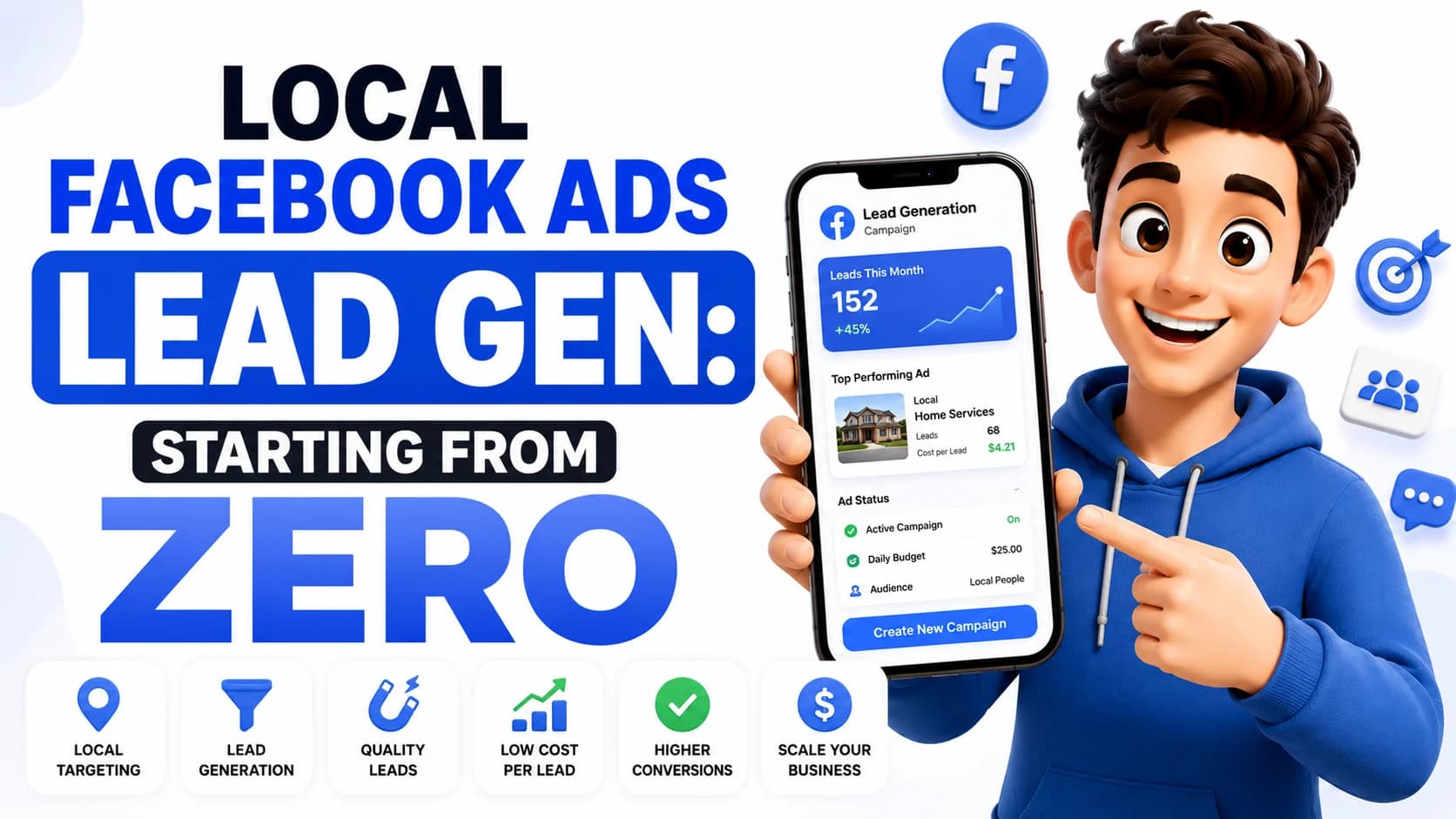
Local Facebook Ads Lead Gen: Starting From Zero
A practical breakdown of how to build a local lead generation business using Facebook ads. Learn everything from picking a niche to managing quotes and markups.
If you had to start a business tomorrow with no personal brand, no contacts, no existing audience, what would actually work? This is one of the more overlooked answers: local service lead generation. Not flashy, not trend-driven, just built on real demand and the fact that most local tradespeople are genuinely bad at marketing themselves. Here's the actual model, step by step.
Step One: Pick the Right Niche
Not every service business works for this. You want something that hits five specific criteria at once, and missing even one weakens the whole model:
- It's service-based, not product-based
- It can only be delivered locally, meaning the provider has to physically show up
- It has a high average job value
- It's fairly standardized; most providers deliver roughly the same thing
- Demand is strong and consistent, not seasonal or trendy
Home services fit this really well. Plasterers, roofers, carpet fitters, and that kind of thing. Take plastering as an example. Service-based? Yes. Local-only? Yes, someone has to physically show up and do the work. That second point matters more than people realize, because it means you're not competing with the entire internet. You're only up against whoever else offers that exact service in your specific area, and that's usually a short list.
Why the Local Angle Actually Works
Go look at how many plasterers in an average town are running real Facebook or Instagram ads. Usually it's under ten. Often under five. And of those, most aren't running anything particularly good. That's the gap. If you can put together the best-looking, best-converting ad in that specific local market, you can realistically dominate lead flow for that service in that area. Compare that to trying to launch a sportswear brand and competing against every major athletic brand on the planet. Completely different playing field.
Job value matters too. A plastering job might run into the thousands, sometimes well beyond that depending on scope. Compare that to a fifty-dollar e-commerce order. The margin for making real money per lead is just structurally bigger here.
Step Two: Find Providers With Actual Capacity
Once you've picked a niche, find the best-reviewed providers in your area using whatever review platforms are common where you are. Start calling down the list. Ask directly if they have capacity to take on more work right now. If yes, great, keep them in mind. If not, move to the next one. While you're at it, ask how much additional work they could realistically handle. You'll need that number later.
Step Three: Run Simple Lead Campaigns
The ad itself doesn't need to be complicated. Before-and-after photos showing a real transformation work well. Keep the copy simple: mention reliability, competitive pricing, clean work, or whatever matters most in that specific trade. Target people over a relevant age range in your local area, and offer a free quote, since most providers already do free quotes anyway, so this doesn't create friction on their end.
Two elements make a real difference in these ads. First, a genuine guarantee, something that actually addresses a real concern the customer has, like "done on schedule or you don't pay." Second, scarcity, using that capacity number you got from the provider. Something like "only taking a limited number of new clients this month" creates real urgency, not manufactured hype, since it's based on an actual constraint.
Set the campaign up as a lead form ad, so people fill out their info without ever leaving Facebook or Instagram. No website needed to get started, which keeps setup fast and cheap.
Step Four: Actually Follow Up
Leads mean nothing without follow-up, and this is where most people quietly drop the ball. Call. If no answer, leave a message and try again later that day. Try the next day again. Persistent, spaced-out follow-up over about a week gets you meaningfully more booked quotes than people who give up after one unanswered call. Once this is working consistently, you can hand this part off to someone else and stop being the bottleneck.
Step Five and Six: Managing Quotes and Your Markup
Now for the part that needs real care. Once a lead is interested, the provider goes out and gives a quote, but the quote comes back to you first, not straight to the client. You then add your markup before passing the number along. If the provider quotes $4,000, you might present it to the client at $6,000. That $2,000 difference is your margin for generating the lead, coordinating everything, and managing the relationship.
Here's the part that actually matters and doesn't get said enough: how you handle this needs to match your local laws. In a lot of places, arranging and marking up regulated trade work, construction, electrical, plumbing, and roofing without holding a contractor's license yourself can legally count as unlicensed contracting, even if you're not swinging a hammer yourself. Rules vary a lot by region and by trade, so this is genuinely worth checking before scaling the model, not after. Being upfront with the client about the arrangement that you're coordinating and vetting a qualified provider rather than doing the work personally is also just the safer, more honest way to run this, and in many places it's a legal requirement rather than a nice-to-have.
Build in a time buffer too. If a provider says four days, tell the client eight. This protects you from delays blowing past any guarantee you've made, and conservative estimates tend to land better with clients anyway.
Step Seven: Scale It
Once the system works in one niche and one area, nothing is stopping you from adding more providers, hiring people to manage bookings and follow-up, and expanding into other services or other locations. This is a genuinely scalable model once the marketing and systems side is dialed in, since your time increasingly goes toward running the machine rather than doing any of the physical work yourself.
On Markups and Trust
People sometimes worry a 50%+ markup is too much for a client to accept. In service businesses, it's honestly pretty normal; plenty of companies charge clients far more than they pay the people actually doing the work. Clients are paying for convenience, vetting, coordination, and the guarantee behind it, not just the raw labor cost.
If a provider does bad work, stop using them and find someone better; there's rarely a shortage of decent tradespeople. Carrying basic liability insurance for yourself is also a smart, low-cost way to protect against the inevitable bad job somewhere down the line.
The Bigger Picture
This model works because most local service providers are genuinely bad at marketing themselves. That gap is the entire opportunity. Get good at local lead generation, build real relationships with reliable providers, and stay on the right side of local licensing and disclosure rules, and this can realistically scale into a serious business over time, built on actual demand rather than chasing whatever's trending this month.
Digital Marketing · October 24, 2026
Back to the front page